Have you asked how your patients are finding you online lately?
For years, the answer would have been, “Oh, I just Googled ‘physiotherapist in Guildford for a nagging knee injury’ and you popped up!” Increasingly, though, you may find that people are asking ChatGPT, getting an AI-generated answer from Google, or chatting to Claude.
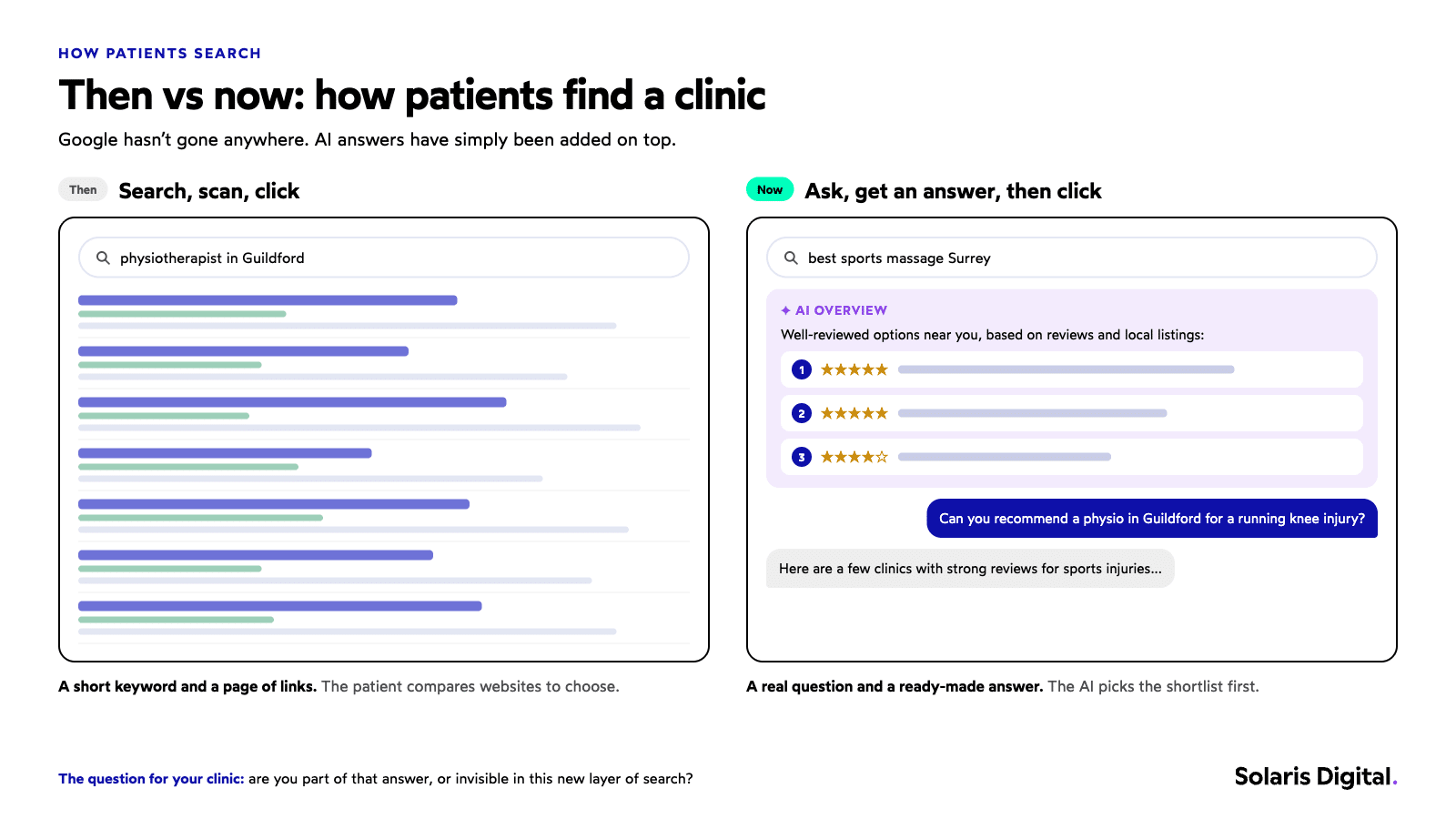
The question for any health clinic owner is: are you showing up in AI, or are you invisible in this new layer of search?
What’s actually changing when patients search AI for a health clinic?
You may have noticed that when you ask a question in Google, it generates AI Overviews to answer you before listing search results. A patient searching ‘best sports massage Surrey’ will likely see a generated recommendation before they see any website links.
If you chat with new patients, you may also find they’ve gone directly to AI tools like ChatGPT, Gemini, or Perplexity to ask conversational questions. This isn’t replacing Google search entirely, but it’s added a new layer on top of it.
The good news is that the health clinics that have great visibility in traditional search tend to also appear in AI-generated answers. There are some specific things you can do to help this.
“When I test AI tools with local health queries, such as ‘best podiatrist in Surrey’ or ‘sports massage near Farnham’, the businesses that come up are almost always the ones with active Google Business Profiles, strong review counts, and content that directly answers patient questions. It’s not magic; it’s the same signals that matter in traditional search, weighted slightly differently.”
Stu Taylor – Solaris Digital Farnham
What do AEO and GEO mean?
Before I get into my advice, I just wanted to explain some terms you may have heard and demystify them immediately:
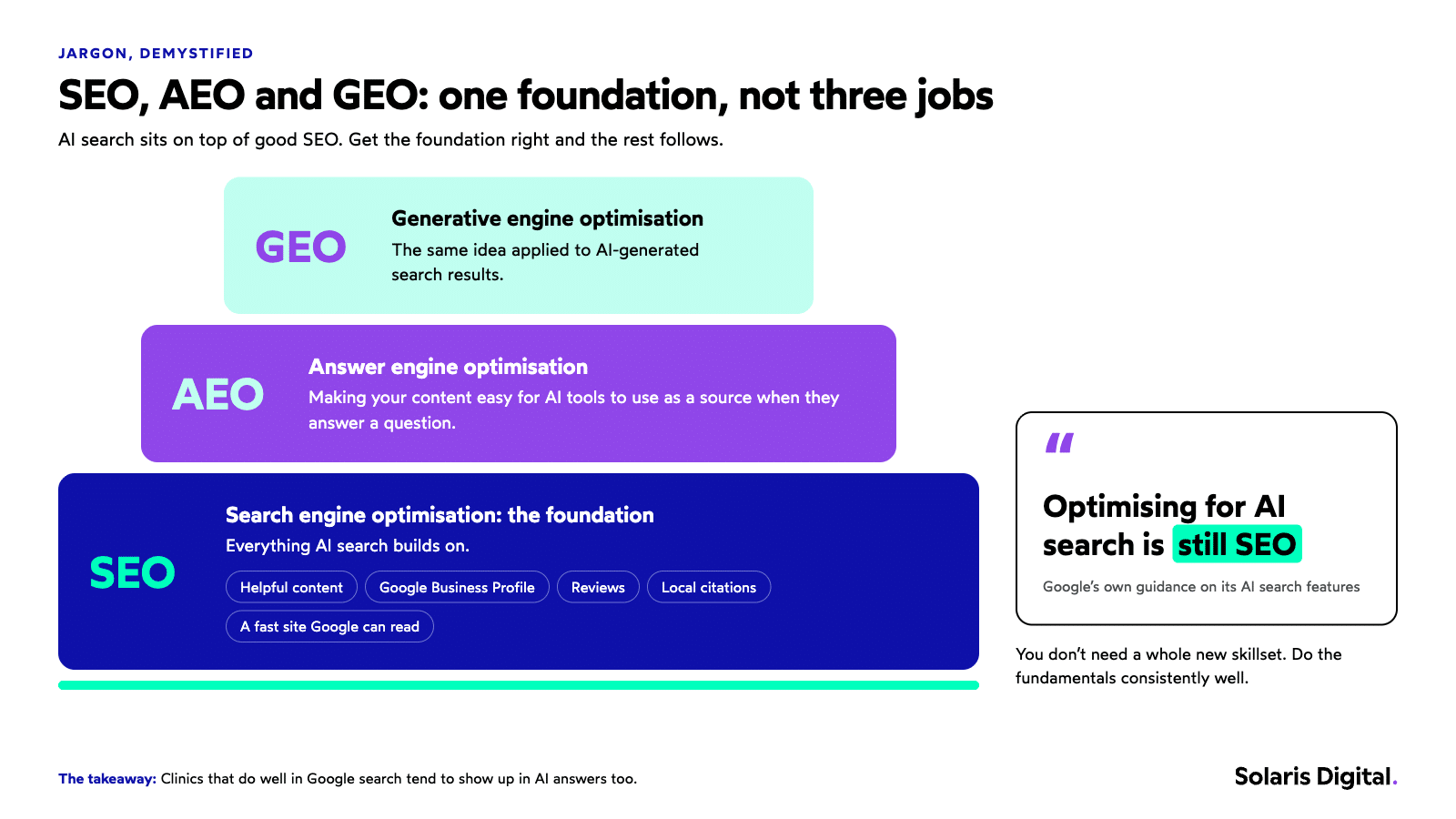
Answer engine optimisation (AEO): this is the practice of making your content easy for AI tools to use as a source when answering a question.
Generative engine optimisation (GEO): a broader term for the same idea applied to AI-generated search results.
But don’t worry, these aren’t whole new skillsets you need to learn! Google’s own published guidance confirms that AEO and GEO are not separate disciplines from SEO. In Google’s words, optimising for AI search is “still SEO”. The fundamentals that help you rank in traditional search for your health clinic still stand:
- Clear content
- Genuine expertise
- A well-maintained Google Business Profile
- Consistent citations
These are the same fundamentals that will help you appear in AI-generated answers.
What this means specifically for your health business
Google’s AI Overviews are already surfacing local health businesses for queries like ‘physio for running injuries near me’, and the ones appearing tend to have active Google Business Profiles with recent reviews and location-specific service pages. It’s local SEO feeding AI search. But I’ve also seen that AI-generated local health recommendations are inconsistent right now.
Here are the things that specifically affect how health clinics appear in AI-generated search answers:
Your content needs to answer real questions: AI tools pull from content that directly answers the questions patients are asking. A blog post titled “How long does plantar fasciitis take to heal?” is more likely to be cited by an AI tool than a generic podiatrist services page. This is why content strategy matters more than ever; not just for Google rankings but for AI visibility.
Your Google Business Profile still matters, possibly more: Google’s AI features explicitly recommend using Google Business Profiles for local business visibility in AI responses. A complete, active profile with real photos and fresh reviews signals credibility to both traditional and AI search.
Being cited elsewhere helps: AI tools tend to recommend businesses that appear across multiple trusted sources, including directories, professional body listings, local press, and review sites. My guide to local SEO for health clinics in Surrey covers citation-building in more depth.
What you don’t need to do
You don’t need to become an AI expert!
There’s a lot of noise in the SEO industry about complex tactics for AI search: special file types, rewriting content in a particular way, or adding specific markup. If this brings you out in a cold sweat, don’t worry; Google’s own guidance says none of this is necessary for its AI features!
“What’s still important is to do the fundamentals consistently well: content that genuinely helps patients, a well-maintained online presence, and a website that Google can read and trust.”
Stu Taylor – Solaris Digital Farnham
Three things to prioritise right now for AI search visibility
There are no quick fixes when it comes to SEO, but over time it builds. If you want your health clinic to be visible in both traditional and AI-generated search, these are my top tips:
1/ Create content that answers patient questions directly
Make it specific, helpful, and written in plain English. You can do this through blogs, FAQs, and condition explainers, as this is what AI tools cite. Using a different hook from the competition and bringing in an original opinion or approach will help you stand out.
2/ Keep your Google Business Profile active and complete
Include photos, reviews, responses and posts. This is the local signal that feeds both maps and AI responses.
3/ Build your presence across trusted sources
Think directories, professional listings, and local press mentions. The wider your credible footprint, the more likely an AI tool is to recommend you.
Start now: support to help you head in the right direction
AI search isn’t something to fear, but it’s something to be aware of. The good news is that, across Surrey and Hampshire, maximising your local SEO and AI search looks a lot like good digital marketing practice. Clinics that invest in genuine, helpful content and a well-maintained online presence are already heading in the right direction.
If you’d like to understand how your health clinic is currently performing in both Google search and AI-generated results, I offer a free consultation for health and wellbeing businesses in Surrey and Hampshire.