If you’re a health clinic owner wondering whether to use an AI website builder for a new website, your curiosity makes complete sense. The AI tools are genuinely impressive; they can generate a website in minutes from a text prompt, produce layouts that look clean and modern, and cost a fraction of a professional build.
So, my honest answer to the question is: for some things, yes.
But if you’re a health clinic that needs to earn patient trust and convert bookings, it’s more nuanced than that. This blog will help you make a smart decision for your website, depending on where you are right now, where you want to get to, and your budget.
What can AI website tools actually do?
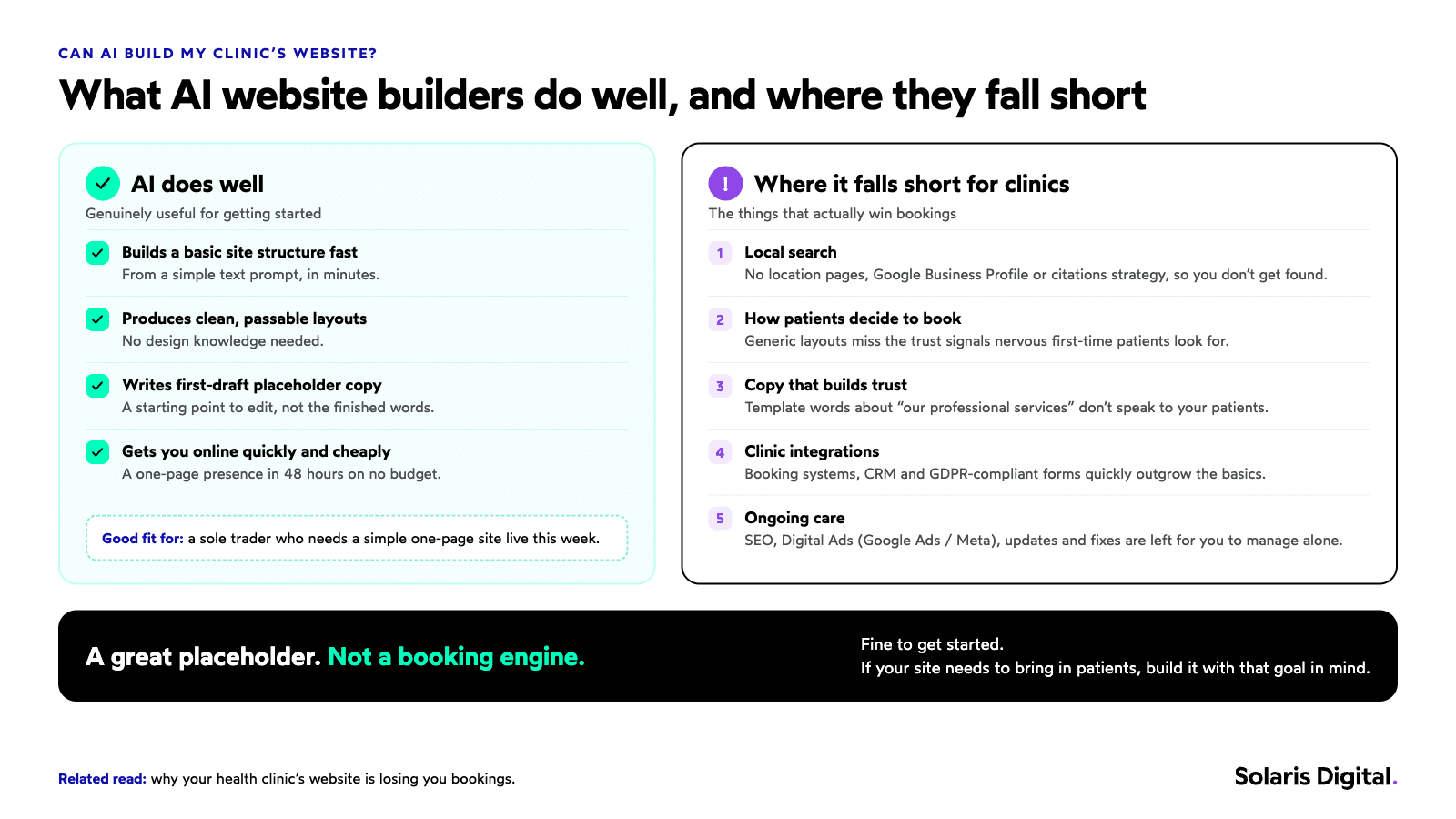
AI website tools deserve credit for what they do well. They can generate a basic site structure quickly from a text prompt, produce passable design layouts without any design knowledge, write generic placeholder copy, and handle simple, template-based sites for very early-stage businesses.
If you’re a sole trader who needs a one-page online presence in 48 hours with no budget, an AI builder might do the job just fine.
The tools I see health clinic owners gravitating toward are Wix’s AI website builder, Squarespace’s built-in AI, and increasingly prompting ChatGPT or Claude to generate copy and layouts. It’s not surprising, since they are all quite heavily marketed. Each has genuine strengths, and the same core limitation when it comes to a clinic that needs to convert bookings.
Where AI website tools fall short for health clinics
This is where it matters for health clinics specifically. Your focus is always going to be on bookings and bringing new clients into your practice. There are five ways I see AI-built websites underperforming, each with a real business consequence attached.
1/ They can’t optimise for local search
An AI builder can produce a website, but it can’t build a local SEO strategy: the location-specific service pages, the Google Business Profile integration, the citation footprint that gets a clinic appearing in “physio near Guildford” searches. This is where most AI-built clinic sites fail silently, looking fine but not getting found.
2/ They don’t understand how patients make booking decisions
Converting a nervous first-time patient requires specific design choices – prominent booking options, visible social proof, clear credentials, or reassuring photography. AI builders produce generic layouts. They don’t know that a health clinic visitor behaves differently from an e-commerce customer.
3/ Generic copy doesn’t build trust
AI-generated placeholder copy is generic. A podiatry clinic in Farnham serving older patients with foot pain needs copy written for that specific person, not a template about “our professional services”. Generic content also performs poorly in search – be super specific about who you are talking to.
4/ They can’t handle the integrations health clinics need
You want streamlined online booking systems, CRM integration, GDPR-compliant forms and appointment management. But AI builders offer basic functionality. If your clinic has any level of operational complexity, you’ll quickly outgrow an AI website.
5/ Ongoing SEO and maintenance falls to you
A professionally built site comes with a relationship – someone you can trust to monitor website performance, make improvements, and respond when something breaks. If you’ve built a website using AI, you’re kind of on your own.
It’s crucially important to build patient trust, boost bookings, show up in search and keep the site updated. So, these shortfalls are worth taking note of.
When AI tools genuinely help in the process
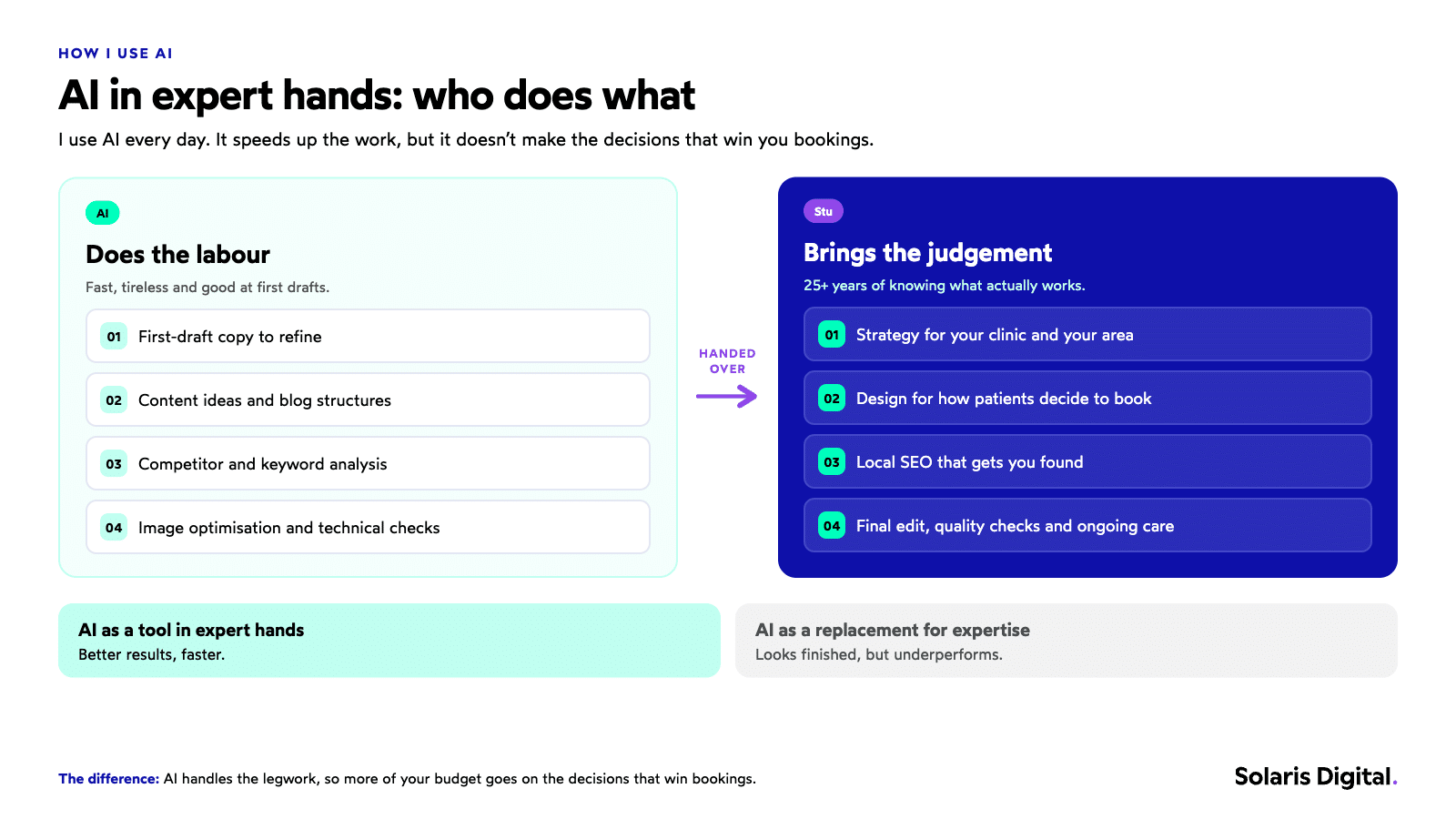
I’m not anti-AI; it’s not the enemy! The tools have a genuine role in the website process, just not as the builder:
- Generating first-draft copy that a human enhances and refines to add brand voice and personality
- Producing content ideas and blog structures
- Analysing competitor sites and keyword opportunities
- Speeding up image optimisation and technical checks
“AI as a tool in expert hands produces better results, faster. But AI as a replacement for years of expertise and wise judgement produces something that looks finished but underperforms.”Stu Taylor – Solaris Digital Farnham
I use Claude for content planning and drafting, AI tools for image optimisation and technical auditing, and a mix of tools for keyword research.
The common thread is direction. I’m directing the AI with expertise, not asking it to replace that expertise. A clinic owner without a web background using the same tools will usually get a less robust result.
The honest answer to “can AI build my clinic’s website?”
If you need a basic online presence quickly and have no budget, an AI builder will get you started. It’s better than nothing, but my advice is to treat it as a placeholder, not a finished solution.
If you want your website to actively generate bookings, rank in local search, convert nervous first-time patients, and grow as your clinic grows, you need a site built with that specific goal in mind – by someone who understands both web design and how health clinic patients think and search.
WordPress vs AI website builder: the real cost
When I’m chatting to clinic owners, I often explain it this way:
“If one new long-term patient is worth £500 to £1,000 in lifetime revenue, a website that generates even two or three additional bookings a month pays for the professional investment many times over within a year.” Stu Taylor – Solaris Digital Farnham
The cost of a professional website for your health clinic, built in WordPress with proper local SEO integration, is typically recovered within months. The cost of an underperforming AI-built site is invisible; it’s the bookings that never came and the patients who landed and left.
You can see some examples of what a professionally built website looks like in the projects I did for Pass and Play and Optimum Health.
How can I help you?
If you’re at the point of thinking about a new website, or wondering whether your current one is working as hard as it should (and whether AI could build it), I offer a free consultation for health clinics in Surrey and Hampshire.
Related read: Why your Surrey health clinic’s website is losing bookings (and how design can fix it)
About Stu Taylor
Stu is the founder of Solaris Digital and is an expert in website design, digital strategy, SEO and digital ads. He has over 25 years’ experience in design and marketing, including 16 years’ running and co-owning a website design agency.